Wednesday, January 27, 2016

Sunday, May 3, 2015
What is a FUNCTION?
A FUNCTION is...
a "RULE" that explains what mathematical operations will be APPLIED to:
- an INPUT (an "X") to produce the OUTPUT (the "Y" value)
- "X" (the INDEPENDENT VARIABLE)
- a NUMBER from the DOMAIN
- to get the VALUE for Y (the DEPENDENT VARIABLE) from a given "X" VALUE
the DOMAIN is the set of possible "X" values
the RANGE is the set of "Y" values
use letters like "f" or "g" or "h" ... to represent a function
f can also be thought of as a MAPPING (Arrow diagram)
showing how (CONNECTS) each
value from the DOMAIN is
matched to a PARTNER in the RANGE
f can also be pictured as a MACHINE that takes
a given INPUT and produce a SINGLE OUTPUT
using a UNIQUE RULE
"x" is an INPUT and
"y" or "f(x)" is the OUTPUT value
f(x) is read as
- f of x
- f operating on x
- f evaluated at x
- the value of f at x
- the image of x under f
An employee for ACME INDUSTRY earns $9 for each hour worked.
To calculate the EARNINGS for a certain individual we
"Multiply the NUMBER OF HOURS (x) by 9"
g(x) = 9 times x
g(x) = 9x
suppose the DOMAIN is {20,30,40}
then the RANGE will be {180, 270, 360}
g(20) = 9(20) = 180
etc.
If ACME INDUSTRY changes the pay rate to $360 for any
employee that works less than or equal to 40 hours in a given week.
When an employee works more than 40 hours they receive an
additional $10 for each hour over 40. This creates the need for a
special type of function called a PIECEWISE DEFINED FUNCTION.
Two different rules are needed. One rule for less than or equal to 40 hours
and a second rule for over 40 hours.
g(x) = 360 ..................... if 0< x <= 40
g(x) = 360 + 10(x-40) .... if 40 < x
REPRESENTING A FUNCTION:
1) VERBALLY (using words)
2) ALGEBRAICALLY (using a formula ... f(x) = 9x )
3) VISUALLY (use a GRAPH)
4) NUMERICALLY (by use of TABLE)
Wednesday, February 18, 2015

Saturday, February 14, 2015
solving equations
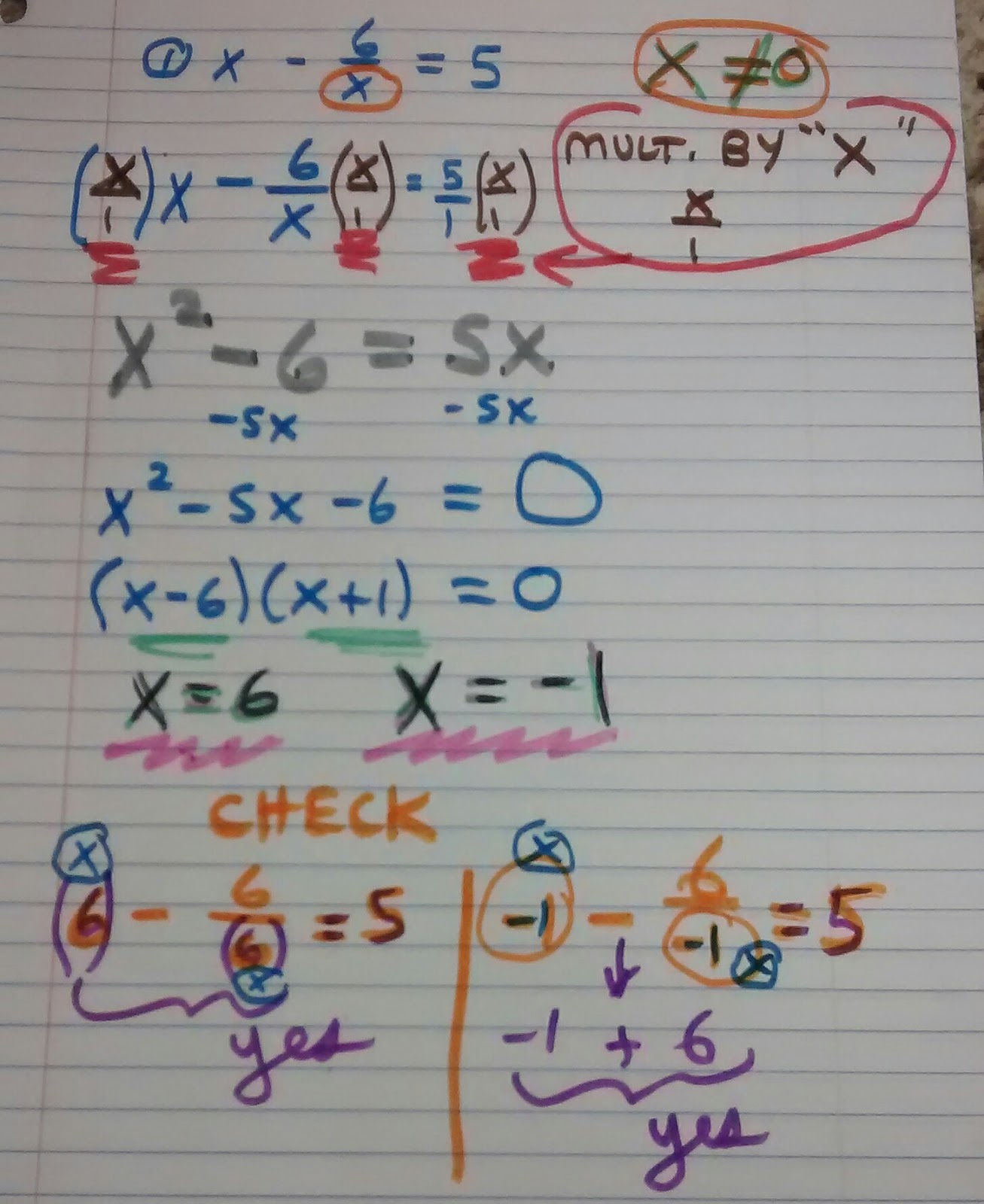
Here are examples with Fractions in the Equations.
Look at #4 for logical steps to follow.
Usually by clicking on an image
you can see a LARGER VIEW.
you can see a LARGER VIEW.


***********************
Below are more simple
type equations


Friday, November 29, 2013


Wednesday, March 20, 2013
Animated Whiteboard Presentations
SOMETHING NEW FOR ME
(Animated Whiteboard presentations):
FACTORING VIDEOS (New as of Feb., 2015)
VIDEO - on Problem 45
VIDEO - on Roots and Absolute Values
VIDEO - Adding Radicals
VIDEO - Two Ways to do a Fraction with Radicals
VIDEO - on using Conjugates
VIDEO - on when to simplify a radical
VIDEO - Combinations & Factorials
VIDEO - Functions
FACTORING VIDEOS (New as of Feb., 2015)
VIDEO - on Problem 45
VIDEO - on Roots and Absolute Values
VIDEO - Adding Radicals
VIDEO - Two Ways to do a Fraction with Radicals
VIDEO - on using Conjugates
VIDEO - on when to simplify a radical
VIDEO - Combinations & Factorials
VIDEO - Functions
Tuesday, January 15, 2013
matrices and determinants
As of Feb. 9th (CLICK HERE!) we will be using a site that I have been building. It is an explanation of MONOMIALS and POLYNOMIALS
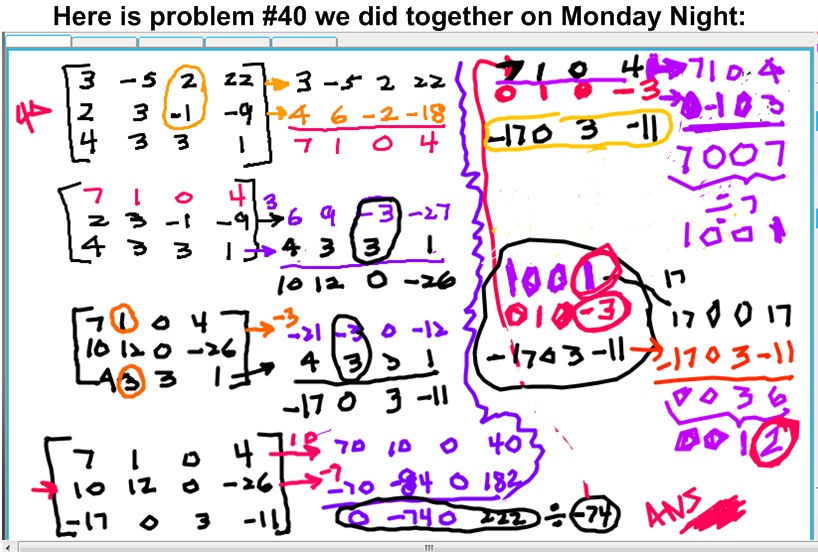

Below is Problem 39 using the ti-83


THE TI-83 to solve 3 equations and 3 unknowns


AUGMENT MATRIX SOLUTIONS


AUGMENT MATRIX SOLUTIONS


How about another example?

How about another example?

&&&&&&&&&&&&&&&&&&&


In problems 7 thru 12 you probably need to
MULTIPLY the FRACTIONS into
the RED MATRIX to get the FINAL INVERSE MATRIX


Subscribe to:
Posts (Atom)